Rockmount Ranch Wear Men's Stonewashed Denim Sawtooth Western Shirt in Sky Blue, 1946 · The originator, still made
Materials
100% Cotton · Impact: lower-mid band
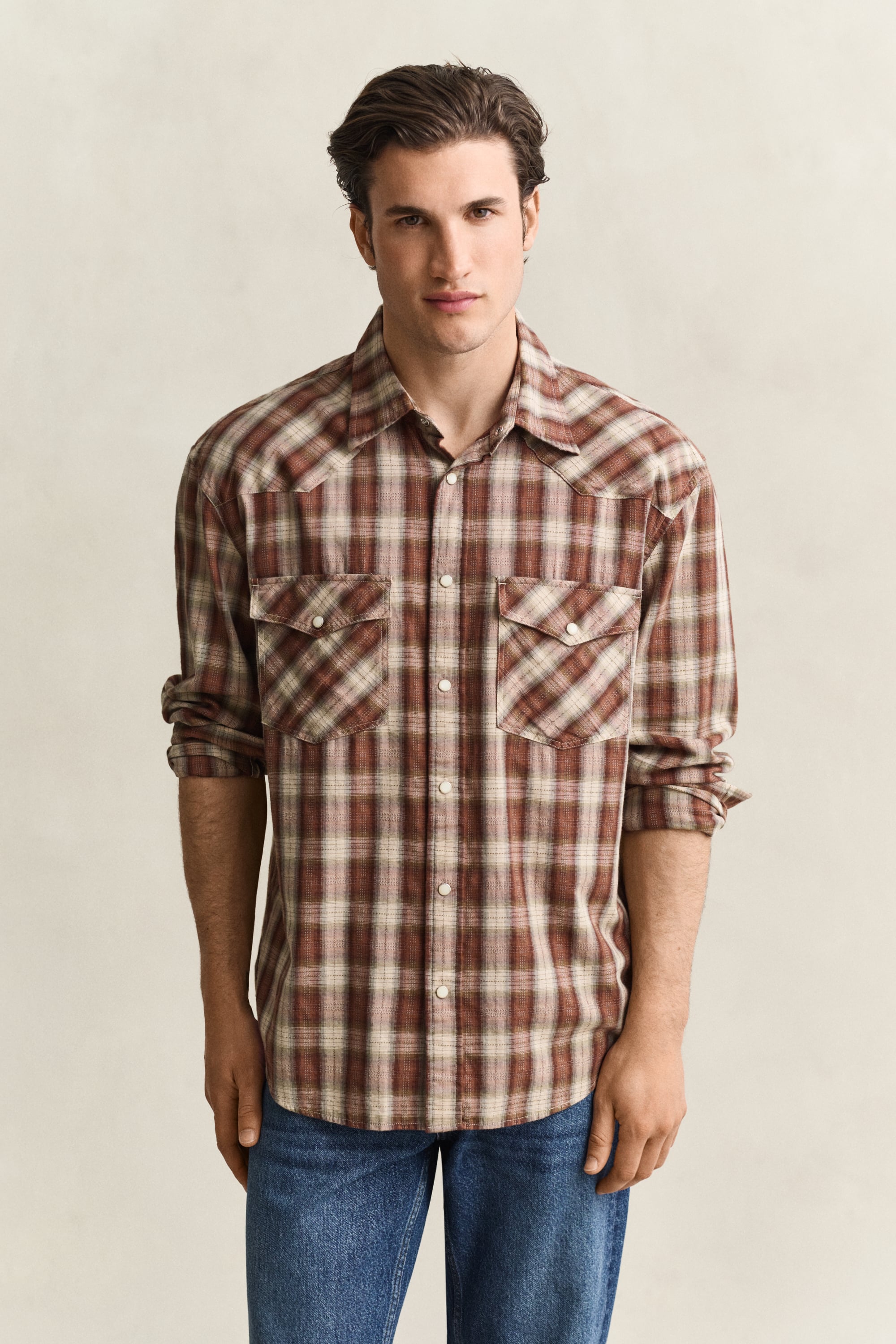
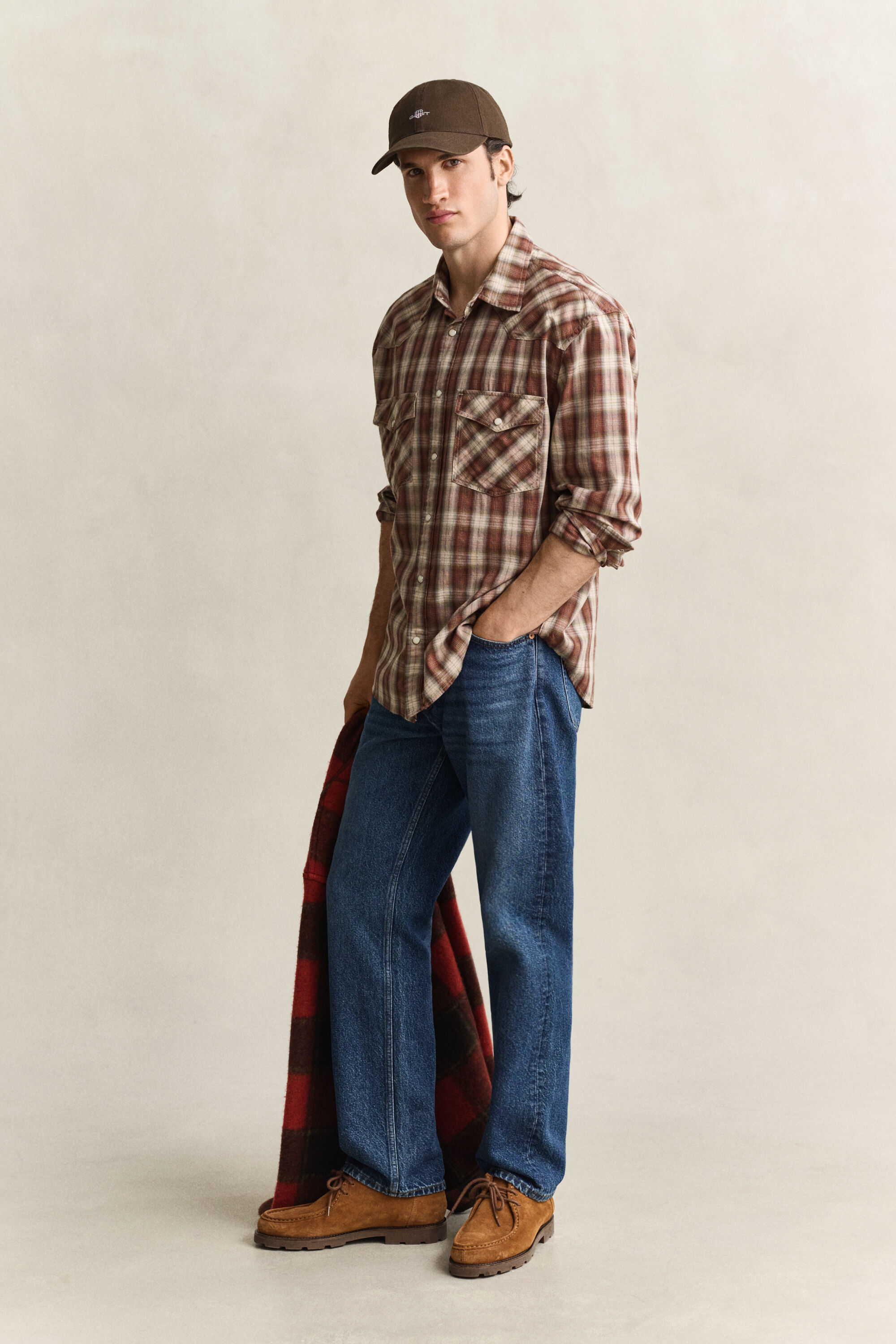
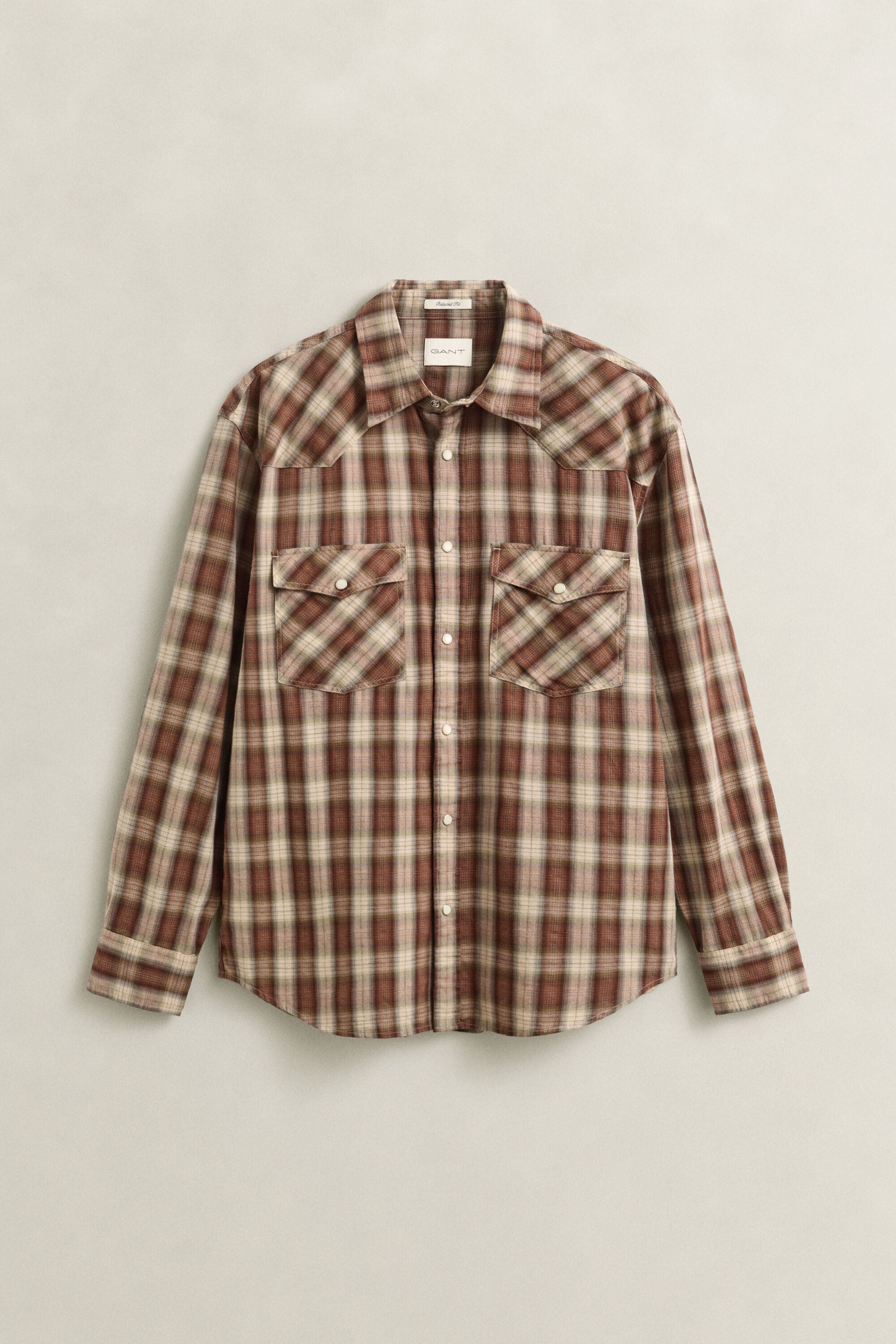
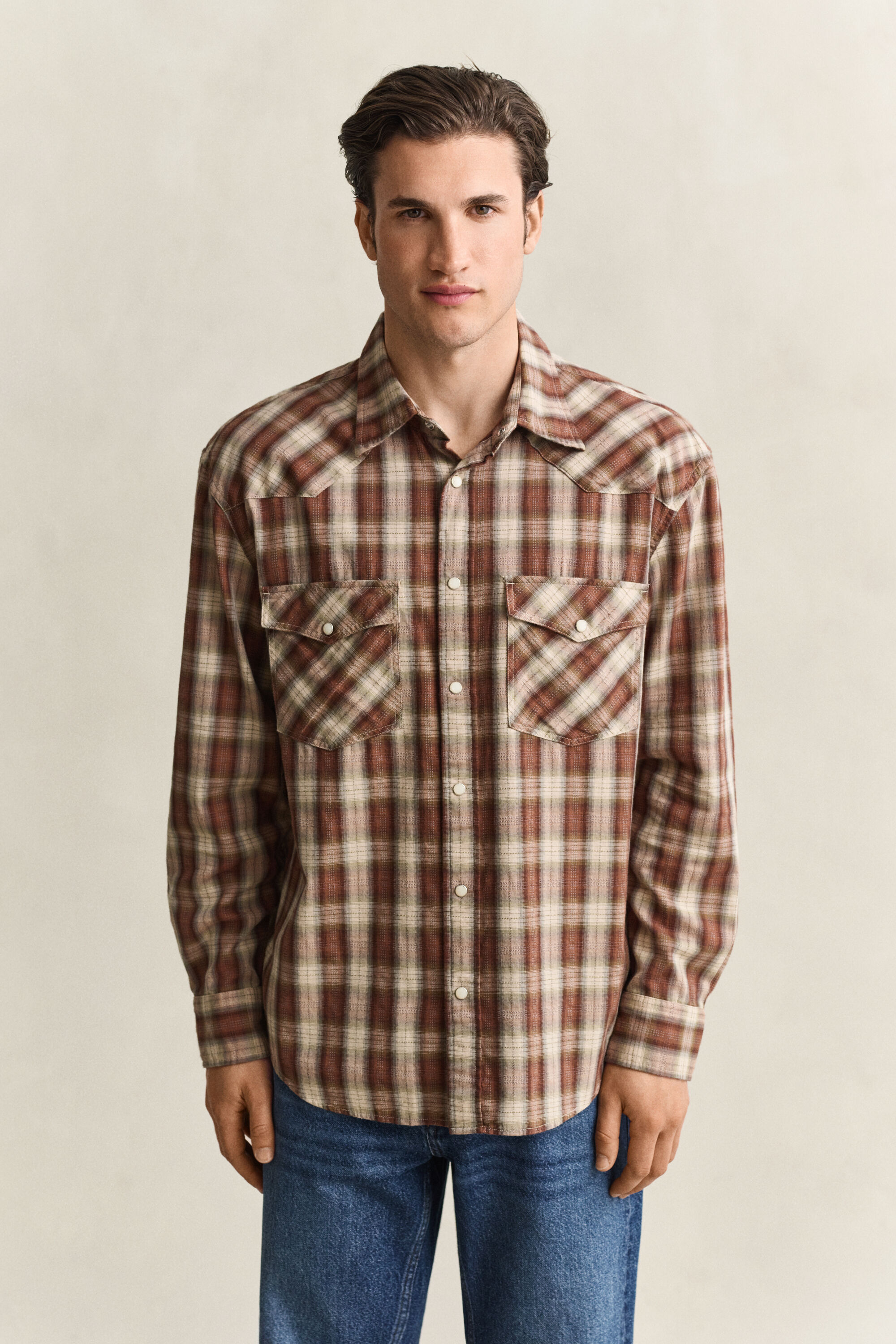
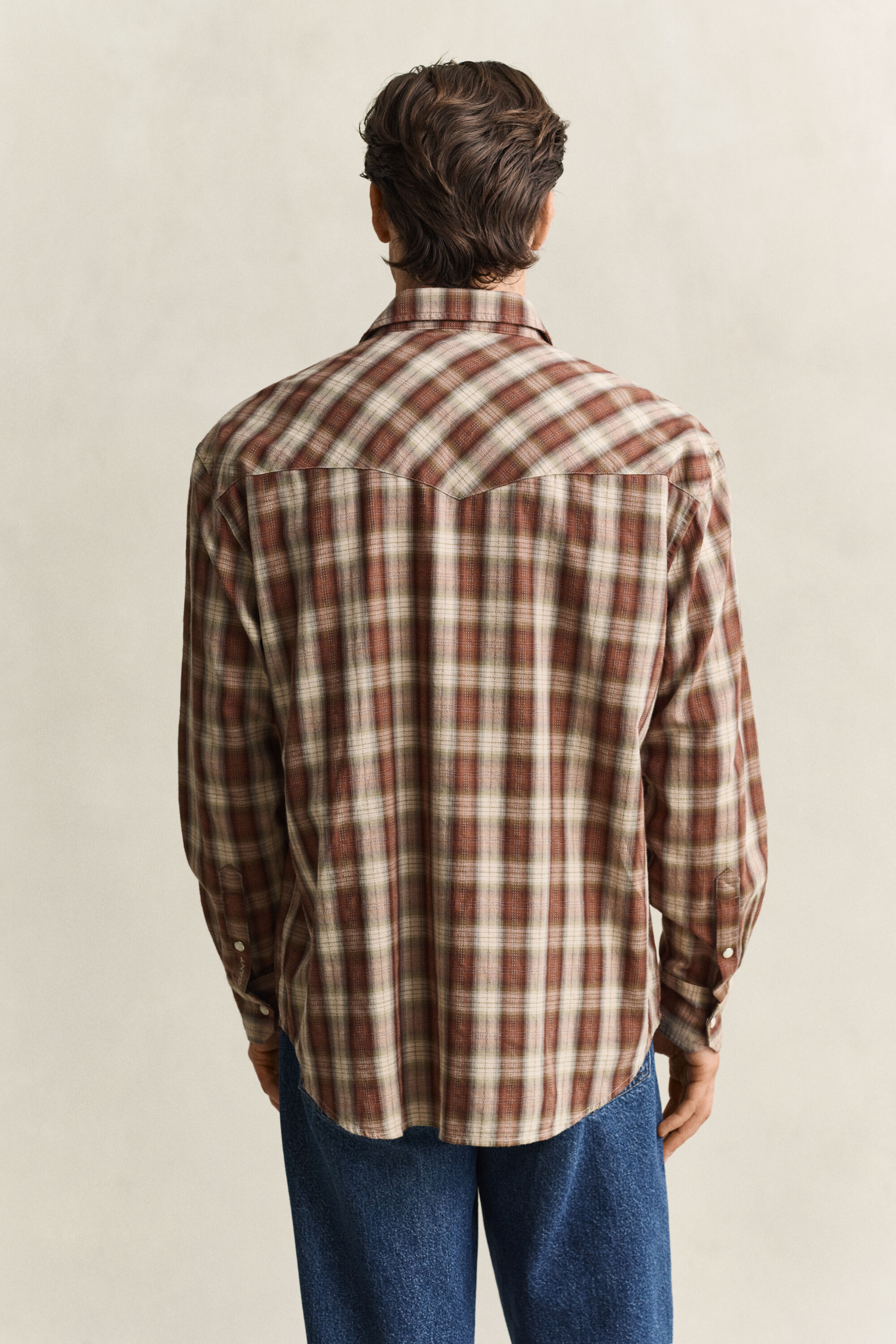
Gant's western shirt in 100% cotton, patterned on the Rockmount Ranch Wear Snap-front Western shirt of 1946. It keeps the front yoke and back yoke; the chest pockets, snap front and chest pockets differ from the Snap-front Western shirt: a single plain patch chest pocket, round snaps and patch pockets with no flap; the button material, snap caps and cloth cannot be made out. The listing says nothing about construction and does not say where it is made.
Reference · the Rockmount Ranch Wear Snap-front Western shirt
The snap-fastened Western shirt was put into production by Jack A. Weil's Rockmount Ranch Wear in Denver. Weil moved to Denver in 1928 and founded Rockmount Ranch Wear there in 1946. His New York Times obituary says he was almost certainly the first to put snaps on Western shirts, which break loose if a shirt catches on a horn and spare the wearer sewing. The original design had sawtooth pockets and diamond pearl snaps. Rockmount calls Weil the inventor of the pearl snap Western shirt.
How the Western shirt changed, 1880s-1920s to present
1880s–1920sThe shirt takes its form from several sources: the yoked, sometimes embroidered shirts of Mexican vaqueros, military bib-front shirts, and show dress. Performers in Buffalo Bill's Wild West shows wear bright, decorated shirts from the 1880s, and silent-film cowboys such as Tom Mix carry the look to the screen in the 1920s.
1930s–1940sImmigrant tailors make the decorated shirt a craft product: Rodeo Ben opens his Philadelphia shop in 1930, Nathan Turk dresses Gene Autry in Los Angeles from the mid-1930s, and Nudie Cohn opens in Hollywood in 1947. Levi's issues a "Dude Ranch Duds" catalogue in 1938. Jack A. Weil founds Rockmount Ranch Wear in Denver in 1946 and sells Western shirts fastened with snaps.
1950s–1960sTelevision cowboys and country singers make the decorated snap shirt familiar, and dude-ranch visitors take it home. Jack B. Weil joins Rockmount in 1954 and sells Western wear east of the Mississippi. Levi's makes its own sawtooth-pocket shirt; Levi's dates the pattern it reissues to 1955, while Clutch Cafe gives 1959 for Levi's first snap shirt. Clark Gable wears a Rockmount shirt in The Misfits (1961). Polyester blends become common from the 1960s.
1969–1980sCountry rock adopts the rodeo tailors' work: Gram Parsons wears a Nudie suit on a 1969 album cover. The film Urban Cowboy (1980) sets off a wider fashion for Western wear and, in Steve Weil's account, takes it to a mass market.
1990s–presentSteve Weil, Rockmount's president from 1991, brings back all-cotton cloths and gabardine. The film Brokeback Mountain dresses its leads in Rockmount shirts. Japanese and American denim makers (Iron Heart, Full Count, Studio D'Artisan, Freenote Cloth) make heavy selvedge versions for the heritage market, while mass-market versions drop many of the signature details; Wrangler's were made in Bangladesh by 2019.
CollarMentioned
The listing mentions it, and the collar cannot be made out.
The collar's shape: a point, a spread, a button-down, an open camp collar, a band, or none.
No clear viewRockmount Ranch Wear Snap-front Western shirtThis product · photo: Gant
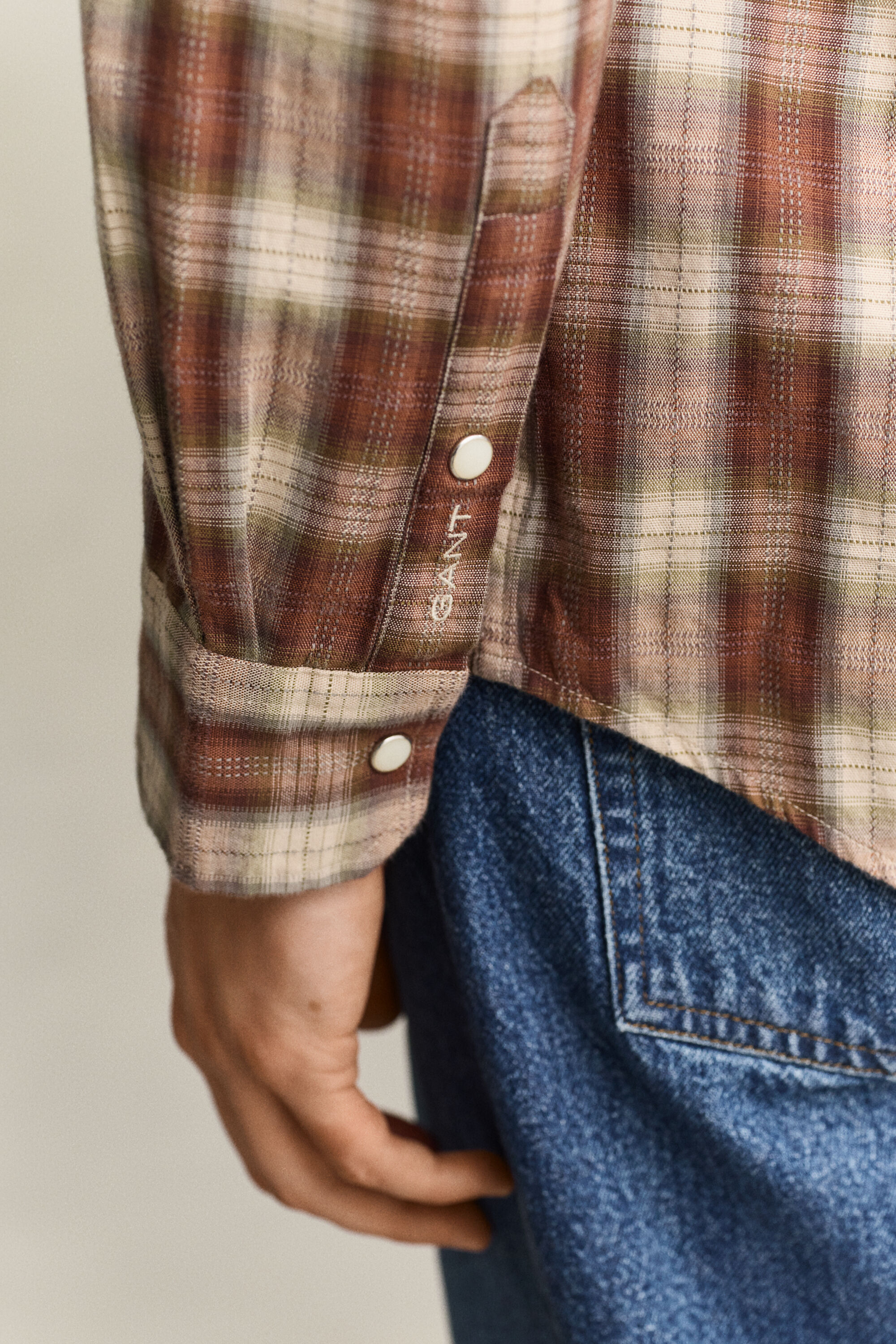
Multi-snap cuffsNot stated
The listing does not say, and the multi-snap cuffs cannot be made out.
The cuff closes with a row of snaps rather than one button. Retailers list three on Wrangler's ranch shirts; the bolder shotgun cuff takes four or five, and a Nathan Turk shirt in the Chicago History Museum has five on each cuff.
No clear viewRockmount Ranch Wear Snap-front Western shirtThis product · photo: Gant
Chest pocketsDiffers
The Rockmount Ranch Wear Snap-front Western shirt has two chest pockets with button flaps; this product has a single plain patch chest pocket.
How many chest pockets, and whether they are plain patches or flapped.
No clear viewRockmount Ranch Wear Snap-front Western shirtThis product · photo: Gant
Button materialUnclear
The listing does not say, and the button material cannot be made out.
What the buttons are made of. Only the listing says; photos cannot tell shell from plastic.
Cannot be confirmed from the listing text; check in person.
No clear viewRockmount Ranch Wear Snap-front Western shirtNo clear viewThis product
Front yokeSame
The Rockmount Ranch Wear Snap-front Western shirt and this product both have pointed front yokes.
A yoke is a separate panel of cloth over the shoulders. On a Western shirt it is cut to a shape, most often one or more points, sometimes a curve or scallop, and it appears on the chest as well as the back, often in a contrasting colour. It began in the 19th century as a second layer to strengthen the shoulders and became the mark by which the shirt is recognised. The back yoke is a detail of its own.
No clear viewRockmount Ranch Wear Snap-front Western shirtThis product · photo: Gant
Back yokeSame
The Rockmount Ranch Wear Snap-front Western shirt and this product both have a pointed back yoke.
The back yoke on a Western shirt is cut to the same shape as the front ones, so the points or curves show across the shoulder blades. Every shirt has a back yoke; what marks the Western shirt is its shape. The front yoke is a detail of its own.
No clear viewRockmount Ranch Wear Snap-front Western shirtThis product · photo: Gant
Snap frontDiffers
The Rockmount Ranch Wear Snap-front Western shirt has diamond-shaped snaps; this product has round snaps.
Snaps replace buttons down the front, on the pocket flaps and at the cuffs. The reason given for them is practical: a snap pulls open if the shirt catches on a horn or a fence, and it cannot come off and need sewing back. The New York Times counted 17 on a Rockmount shirt. The diamond shape is Rockmount's own; most other makers use round snaps.
No clear viewRockmount Ranch Wear Snap-front Western shirtThis product · photo: Gant
Snap capsUnclear
The listing does not say, and the snap caps cannot be made out.
A "pearl snap" is a metal snap with a pearl-look cover. The cap may be real mother-of-pearl shell or a plastic made to look like it, and a listing that says only "pearl snap" has not said which. [CHECK] No source read for this draft states how common synthetic caps are or what they cost against shell; Levi's Vintage Clothing and Stan Ray both state mother-of-pearl on their own shirts.
No clear viewRockmount Ranch Wear Snap-front Western shirtNo clear viewThis product
Chest pocketsDiffers
The Rockmount Ranch Wear Snap-front Western shirt has two pockets with sawtooth (two-point) flaps; this product has patch pockets with no flap.
Two chest pockets closed by flaps that snap shut, so the contents stay put on horseback. The flap is cut to a shape: a single point, or the sawtooth, whose two points look like the teeth of a saw and which Rockmount pairs with its diamond snaps. Tailors' shirts instead carry smile pockets, a curved slit bound with piping and finished at each end with a stitched arrowhead that also stops the opening from tearing.
No clear viewRockmount Ranch Wear Snap-front Western shirtThis product · photo: Gant
PipingNot stated
The listing does not say, and the piping cannot be made out.
Piping is a narrow strip of cloth folded into a cord and sewn into a seam, usually in a contrasting colour, to outline the yokes, the front, the cuffs and the collar. It comes from tailoring and is the mark of the dress shirts made by the California rodeo tailors; plain ranch and denim versions do without it.
No clear viewRockmount Ranch Wear Snap-front Western shirtThis product · photo: Gant
EmbroideryNot stated
The listing does not say, and the embroidery cannot be made out.
Dress versions carry embroidery on the yokes, the collar and the back: flowers, horses, wagon wheels. It began as show dress, so that a rodeo or stage performer could be picked out from a distance. Nudie Cohn's embroidery was chain stitch. [CHECK] No source read explains how chain-stitch embroidery differs in cost or look from programmed multi-head embroidery; Put This On reported in 2018 that Rockmount's embroidered shirts, unlike its plain chambrays and denims, were not made in the USA.
No clear viewRockmount Ranch Wear Snap-front Western shirtThis product · photo: Gant
ClothUnclear
The listing mentions it, and the cloth cannot be made out.
The shirt is made in whatever cloth suits its use: denim and chambray for work, plain or plaid cotton for everyday wear, gabardine for the tailors' dress shirts. Polyester blends became the norm from the 1960s, and Heddels reports that fine all-cotton cloths and gabardine were largely missing from Western shirts for about thirty years after that.
No clear viewRockmount Ranch Wear Snap-front Western shirtNo clear viewThis product
Construction
Expected at this price2 detailsWhat a western shirt should state
Stated by the listing0 of 2Nothing on seams, tacks or finishing
What it does sayPoint collarand chest patch pocket, snap button, patch pocket and 100% cotton; no construction claims
A well-made Western shirt usually has double-needle seams, flat-felled seams; the listing does not say. Silence is not a verdict: a maker that does these things usually says so, and each can be checked in a minute with the product in hand.
Double-needle seams
Listing: not stated
Two parallel rows of stitching along a seam, sewn at once by a two-needle machine or in two passes.
What it tells you
Stronger seam that resists pulling apart under stress; standard on well-made outerwear and workwear. Not a marker of luxury, but its absence on a jacket is worth noticing.
How to check it yourself
Look along the main body and sleeve seams from the outside for two even rows of stitching a few millimetres apart.
Flat-felled seams
Listing: not stated
A seam where one seam allowance is wrapped around the other and stitched down flat, enclosing all raw edges, with two visible rows of stitching on the outside.
What it tells you
A durable, clean-finish seam that costs more time and fabric than an overlocked seam. The traditional finish for the outseams and yokes of jeans and workwear.
How to check it yourself
From the outside, two parallel rows of stitching with the seam lying flat. From the inside, no raw or overlocked edge is visible; the seam is a smooth folded ridge.
Composition and materials
100% CottonAs the listing states it
100% Cotton
Composition, as listed: “100% Cotton”. Which part of the product the figure covers is not said; Docent treats it as the shell.
Beside the original
Rockmount Ranch Wear Men's Stonewashed Denim Sawtooth Western Shirt in Sky Blue: 100% cotton denim. Made in USA.
This product: 100% Cotton; which part it covers not stated.
Feel and drape
Soft, breathable, absorbs moisture readily. Drape depends entirely on the weave or knit: crisp in poplin and gabardine, soft in jersey and loopback.
Durability
Good abrasion resistance; weakens when wet and is prone to shrinkage on first wash unless pre-shrunk. Longer staple lengths pill less and last longer.
Care
Machine washable. Shrinks and fades with heat; wash cool and line dry to extend life. Wrinkles easily.
Environmental
Renewable and biodegradable, but conventional cultivation is water- and pesticide-intensive in many growing regions. Organic cultivation reduces chemical inputs; it does not by itself reduce water use.
Environmental impactcomposite 2.4 of 5 across five dimensions, all of the composition scored
Lower
Lower-mid
Mid
Higher-mid
Higher
Raw material inputsHigh irrigation water and pesticide use in conventional cultivation; varies strongly by region.
Processing intensityScouring, bleaching and dyeing are chemical- and water-intensive; comparable to other cellulosics.
Microfibre sheddingSheds fibers in washing like all textiles, but the fibers biodegrade.
End of lifeBiodegradable when undyed or with low-impact dyes; mechanically recyclable with fiber-length loss.
DurabilityLong service life when cared for; staple length is the main variable.
Fibre-level estimates from Docent's rubric, weighted by share of the composition; not a measurement of this product. Organic or recycled variants score differently and are shown when the listing names them.